If it feels like employment laws are changing faster than ever, 2026 is proving you right. The state legislation trends shaping 2026 are already in sharp focus — and we're only halfway through the year.
Here's what's gaining momentum, and what employers need to know to stay ahead.
1. Pay Transparency: Beyond Salary Range Disclosure
Pay transparency laws have been growing for years, and roughly a third of U.S. states now require employers to include wage ranges in job postings. In 2026, legislators are pushing further.
Several states are considering bills that would require greater transparency throughout the hiring process — not just in what a job pays, but in whether the job exists. These proposed laws target so-called "ghost jobs," requiring employers to post only genuine openings and to disclose when a candidate has already been identified.
For employers, this trend signals a continued push toward accountability in recruiting — and greater compliance complexity as requirements vary by state.
- Salary range disclosure is now the baseline, not the ceiling
- New proposals target misleading or "ghost" job postings
- Patchwork of state laws creates multistate compliance challenges
2. Expanded Paid Leave Rights
The expansion of paid leave continues to be one of the most active areas of state employment legislation. In 2026, states are building on existing paid sick leave frameworks to broaden both the scope of covered leave and the employees entitled to it.
Proposals include expansions to paid family and medical leave programs, increased accrual rates and — in a notable development — new accommodations for menopause-related conditions. Rhode Island enacted a first-of-its-kind law in 2025 requiring employers to accommodate certain menopause-related conditions, and Philadelphia, Pennsylvania followed suit with similar protections covering menstruation, perimenopause, and menopause.
Employers operating in multiple states face the ongoing challenge of tracking different accrual rules, eligibility thresholds and covered conditions across jurisdictions.
- Paid family and medical leave programs are expanding in scope and reach
- Rhode Island and Philadelphia set new precedents for menopause accommodation
- Multistate employers face growing complexity in leave administration
3. Restrictions on Noncompete Agreements
State-level limits on noncompete agreements have been gaining ground for several years, and 2026 is no exception. While the FTC's attempt at a federal ban was struck down, states are filling the void with their own restrictions — ranging from outright bans to tighter limits on who can be bound (and under what circumstances).
Employers that use noncompetes to protect trade secrets and retain their workforce are facing a changing legal landscape. Some states are restricting noncompetes to high-earning employees only; others are shortening maximum durations or requiring advance notice before employment begins.
- More states are enacting outright bans or significant restrictions
- Income thresholds are becoming a common dividing line for enforceability
- Employers should audit existing agreements for state-by-state compliance
4. AI in Employment Decisions
Artificial intelligence continues to be one of the most active — and contested — areas of state employment regulation. In 2026, many states are moving ahead with legislation that would govern how employers use AI tools in hiring, promotions and performance evaluations.
Most proposals fall into categories focused on algorithmic bias audits, notice requirements to job applicants and prohibitions on using AI as the sole basis for adverse employment decisions. In December 2025, President Trump signed an executive order directing the Department of Justice to challenge state AI laws it views as unconstitutional burdens on commerce — but that has not slowed legislative activity at the state level.
The bottom line for employers: AI compliance is becoming a state-by-state patchwork, and organizations using AI-driven tools in HR processes need to track where they operate.
- States are requiring bias audits and impact assessments for AI hiring tools
- Notice and disclosure requirements to applicants are common features of new laws
- Federal pushback has not halted state-level AI regulatory activity
What's legal in one state may be prohibited in the next. For multistate employers, staying compliant means staying informed — all year long.
5. Immigration Compliance: E-Verify and State Mandates
Immigration remains a top legislative priority in 2026, with states taking two distinct approaches. Some — like Indiana, whose SB 76 takes effect July 1, 2026 — are cracking down on the employment of unauthorized workers, requiring employers to demonstrate "reasonable diligence" through E-Verify or equivalent practices, with potential penalties including suspension of business operations. Others are focused on worker protections: Washington's Immigrant Worker Protection Act (HB 2105, effective October 1, 2026) requires employers to notify workers within five business days of a federal I-9 inspection notice. States like New Jersey, Rhode Island and South Dakota are also considering bills that would extend E-Verify requirements to most private employers.
- State immigration laws are pulling in two directions: employer enforcement and worker protection
- Indiana mandates reasonable diligence in work authorization, with E-Verify as the primary safe harbor
- Washington requires timely worker notification during federal I-9 inspections
- E-Verify mandates for private employers are advancing in multiple states
6. Workplace Safety: New Rules at the State Level
With federal OSHA activity limited in some areas, states have stepped in with their own workplace safety requirements — and 2026 is seeing a notable wave of new rules and proposals.
Key developments include:
- Workplace Violence Prevention in Healthcare (New York)
In December 2025, New York enacted a law requiring hospitals and nursing homes to implement workplace violence prevention programs, conduct annual safety and security assessments, and maintain trained security staff. Phased implementation begins in 2027.
- Retail Worker Safety Act (New York)
As of June 2, 2025, New York employers with 10 or more retail employees must have formal workplace violence prevention policies, training programs and employee notice requirements in place. The law addresses risks such as robbery, harassment and assault.
- Expanded OSHA Protections for Domestic Workers (California)
On July 1, 2025, California extended protections to domestic workers — including house cleaners and caregivers — requiring hazard training, safe equipment and general workplace safety standards that previously did not apply in many home settings.
- Heat and Cold Weather Safety (Arizona and Multiple States)
Arizona's state OSHA plan issued guidance on Heat Illness Prevention Plans in 2025–2026, covering water, rest, shade and training. Several other states are advancing cold weather worker safety proposals to address gaps where federal OSHA has no standard, with rulemaking expected to accelerate in 2026.
- PPE Fit Requirements (Nevada)
In 2025, Nevada adopted the federal rule requiring properly fitted personal protective equipment in construction — clarifying that PPE must be sized and fitted to each individual worker to be effective.
What Employers Should Do Now
The second half of 2026 is when many of these legislative proposals will either advance or stall in committee. The time to prepare is now, not after a law takes effect.
Employers should take stock of which states they operate in, assess their exposure to each of these six trends, and ensure their HR policies, job postings, hiring tools, and safety programs are ready to adapt.
Stay Ahead of State Law Changes
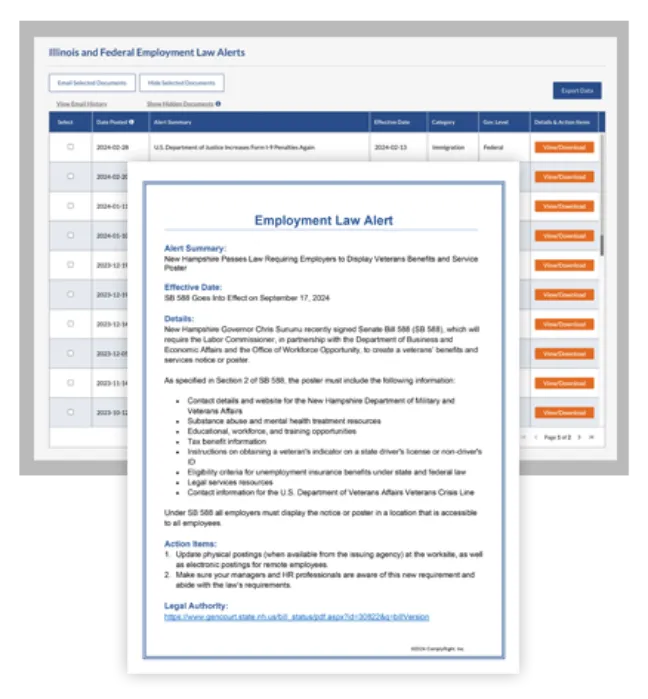
Keeping up with state-by-state employment law changes is a massive undertaking. Our Employment Law Alert Service monitors legislative and regulatory developments across all 50 states — so you know what's changing, what it means for your business and what you need to do about it.